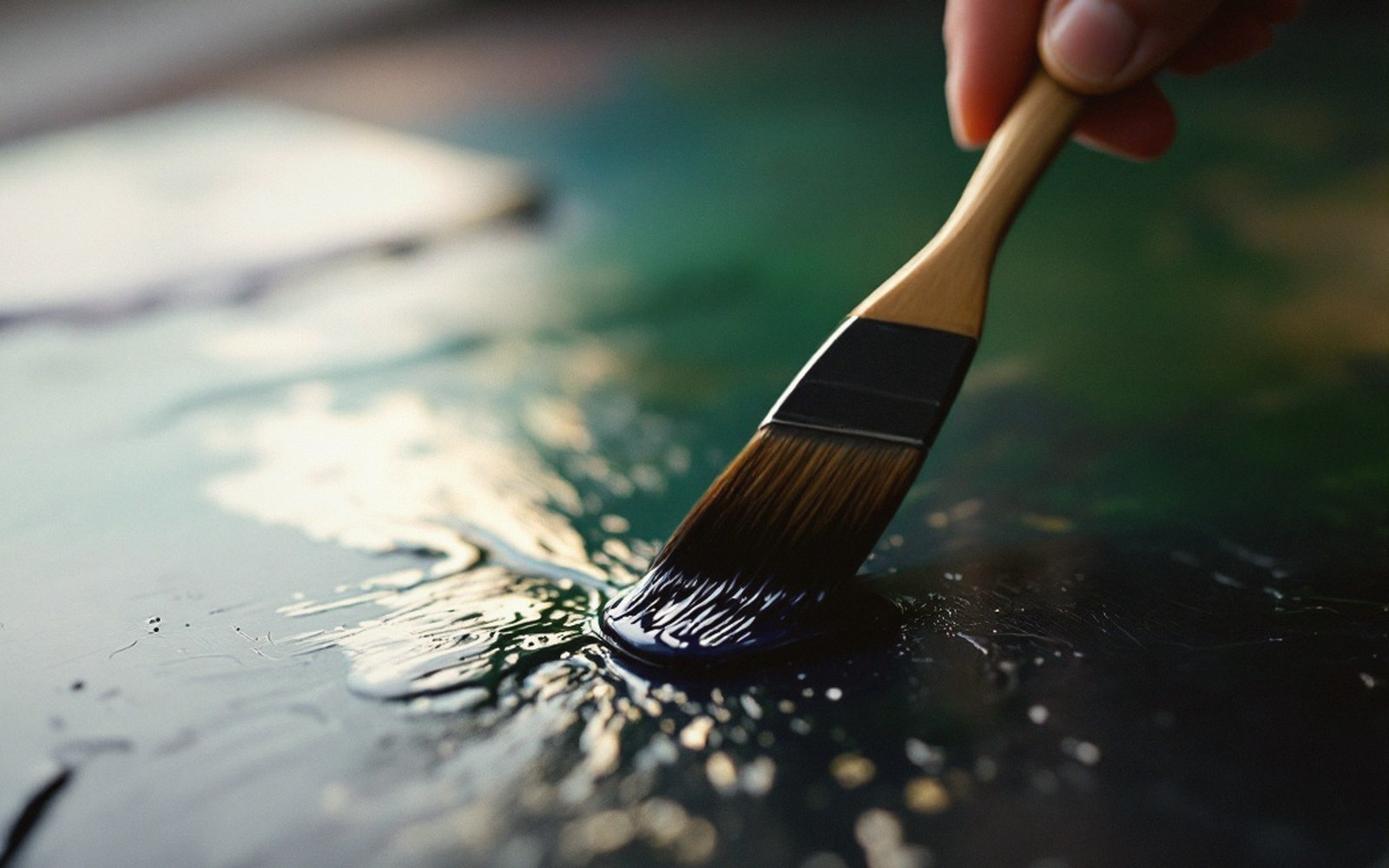
Varnished painting surface at an oblique angle, a single light source catching the sheen across the paint film
Image: Gering & LopezLayer 5 of seven
VARNISH
The removable skin on top — what it changes optically, why it yellows, and when to leave it alone.
Where VARNISH sits
The stack, back to front, with band depth set by how much each layer carries here. VARNISH is layer 5 of seven.
BEHIND IT ▼ PAINT
IN FRONT OF IT ▲ LIGHT
What to look for in this layer
- Refractive index
- how much a material bends light passing through it; a large mismatch between air and pigment scatters light; a narrower mismatch (resin and pigment) lets colour come throughFrom “The Layer That Deepens Everything” →
- Damar
- natural resin, high initial gloss, yellows and hardens with age, eventually requires stronger solvents to removeFrom “Natural Resin Against the Polymer” →
- Varnish
- a removable resin layer applied over dry paint; historically dammar or masticFrom “This Is Where You Stop” →
Everything in VARNISH
3 pieces.
- The Layer That Deepens EverythingDescribes the optical effect of varnish on a dry paint surface — saturation increase, gloss, the way shadows deepen — and explains why a varnished picture and an unvarnished one of the same subject look like different objects.2 min read
- Natural Resin Against the PolymerA comparison of damar resin varnish and modern synthetic alternatives — yellowing rates, reversibility, gloss level, solubility — without prescribing which to use. Presents the trade-offs and leaves the decision to the reader.3 min read
- This Is Where You StopExplains what surface cleaning of varnish involves, why the margin between removing dirt and removing paint is almost invisible, and marks clearly the point at which the piece must go to a trained conservator. Does not provide cleaning instructions.2 min read