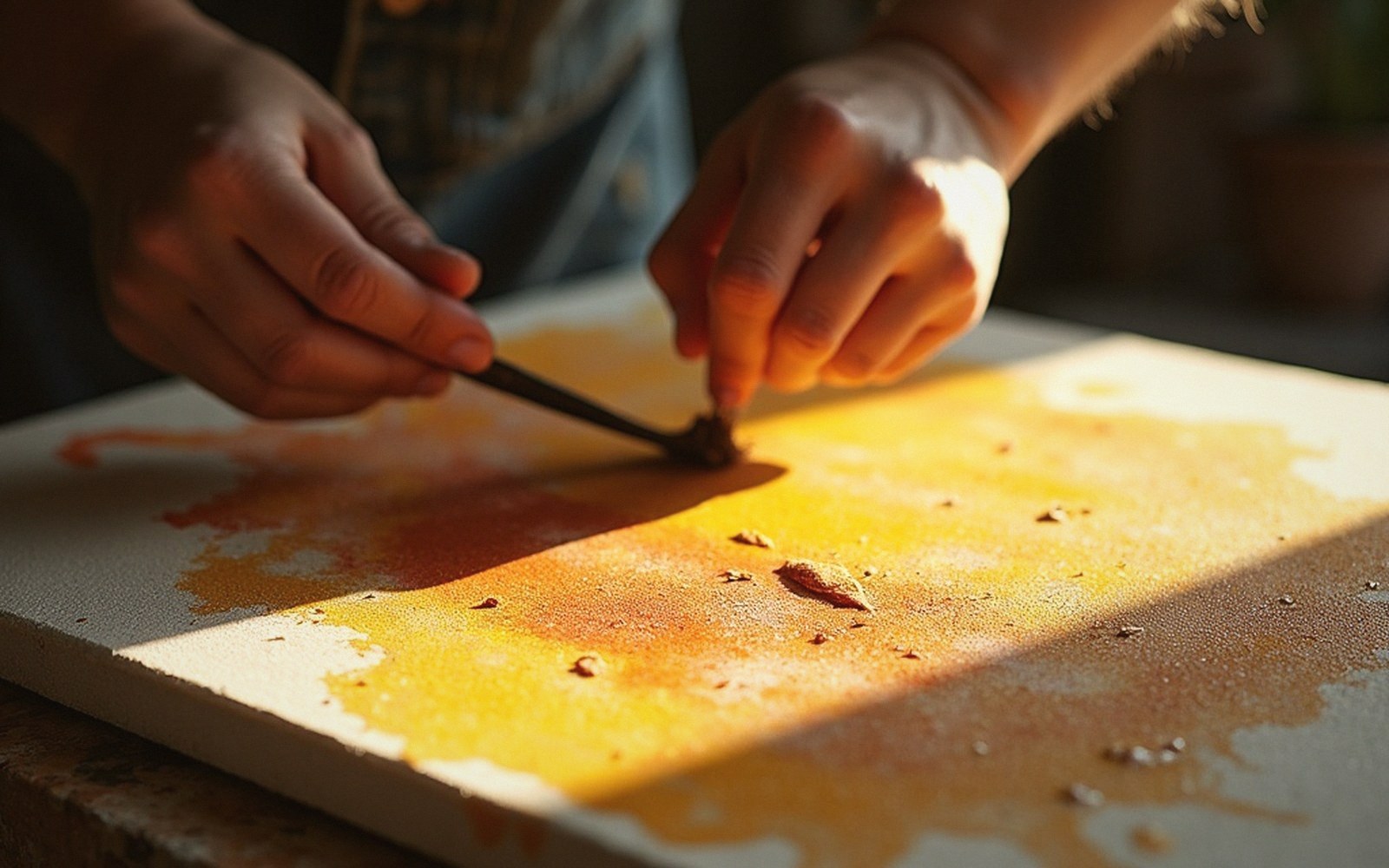
Raking side-light across a thickly painted canvas surface, impasto ridges casting fine shadows, warm amber light source from the left
Image: Gering & LopezLayer 6 of seven
LIGHT
How a painting changes with the direction, colour and quantity of light — and how to use that when looking.
Where LIGHT sits
The stack, back to front, with band depth set by how much each layer carries here. LIGHT is layer 6 of seven.
BEHIND IT ▼ VARNISH
IN FRONT OF IT ▲ FRAME
What to look for in this layer
- Brushwork
- direction, pressure and drying sequence become readable from shadow edgesFrom “What Raking Light Shows That Normal Light Hides” →
- First 30 seconds
- settle; let the eye find its anchor pointFrom “More Than Eight Seconds” →
- Kelvin (K)
- the unit for measuring the colour of light; lower = warmer (orange), higher = cooler (blue-white)From “The Wrong Bulb Changes the Picture” →
- Impasto
- Italian origin, meaning roughly “dough”; paint applied thickly enough to hold the three-dimensional shape of the tool that made itFrom “When the Paint Casts a Shadow” →
Everything in LIGHT
4 pieces.
- What Raking Light Shows That Normal Light HidesAn explainer on raking light — a single source held low and to the side — and the surface information it reveals: brushwork, pentimenti, cracking patterns, canvas texture. Tells the reader how to replicate it at home with a phone torch.3 min read
- More Than Eight SecondsA practical piece on how to look at a painting for longer than instinct allows — where to start, what to follow, how long different kinds of attention take to develop. The site's flagship piece on the act of looking.7 min read
- The Wrong Bulb Changes the PictureExplains colour temperature in lighting — measured in Kelvin — and how tungsten, daylight and LED sources shift the apparent hue of the same paint surface. Practical for anyone choosing how to hang a picture at home.2 min read
- When the Paint Casts a ShadowFocuses on heavily built paint surfaces — impasto — and how directional light turns the surface into a relief map of the painter's decisions. Argues that impasto is better understood as sculpture than as colour.2 min read