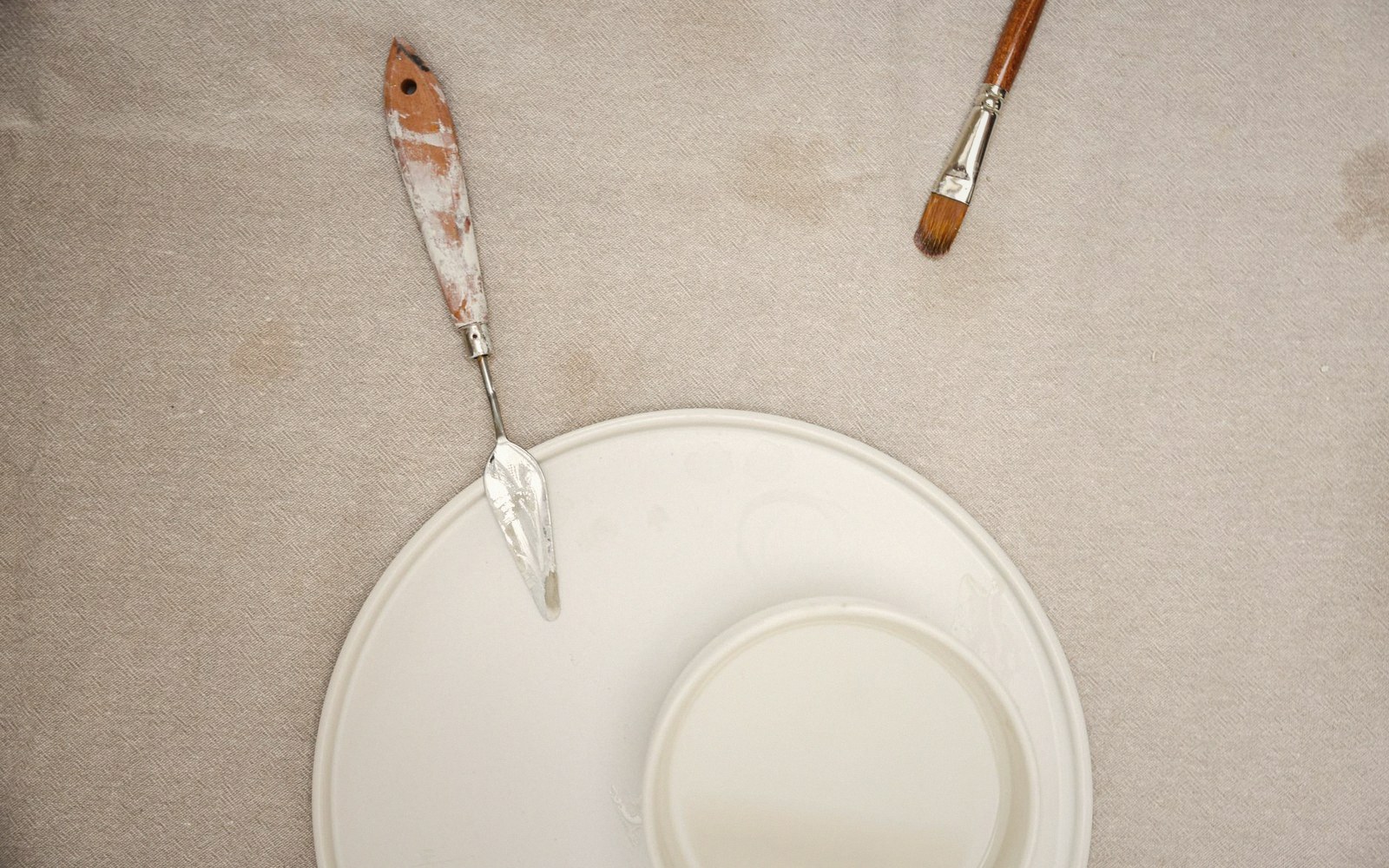
A wide flat brush loaded with warm white paint, tip pressed lightly against a primed canvas edge, palette in background
Photo: Cup of Couple / PexelsLayer 3 of seven
GROUND
Gesso, chalk, lead white — the white layer everything sits on and why its recipe changes everything above it.
Where GROUND sits
The stack, back to front, with band depth set by how much each layer carries here. GROUND is layer 3 of seven.
BEHIND IT ▼ CANVAS
IN FRONT OF IT ▲ PAINT
What to look for in this layer
- Gesso (traditional)
- chalk or gypsum powder bound in warm rabbit-skin glue; applied in layers to a rigid support, usually woodFrom “Gesso: the White Everything Sits On” →
- Warm ochre/red-brown ground
- Velázquez, Rubens, Spanish and Flemish BaroqueFrom “When the Ground Is Not White” →
- Oil over acrylic
- stable and acceptedFrom “Two Whites That Are Not the Same” →
Everything in GROUND
3 pieces.
- Gesso: the White Everything Sits OnWhat traditional gesso actually contains — chalk and rabbit-skin glue — and how it differs from the acrylic dispersion sold as gesso today.7 min read
- When the Ground Is Not WhiteExplains why painters have historically toned their grounds warm ochre, grey or mid-green, and how the ground colour bleeds through to the finished surface. Factual, with historical technique examples.4 min read
- Two Whites That Are Not the SameA comparison of oil-based and acrylic grounds — absorbency, flexibility, drying behaviour, long-term compatibility. Helps a reader understand why the choice of ground affects every layer above it.2 min read