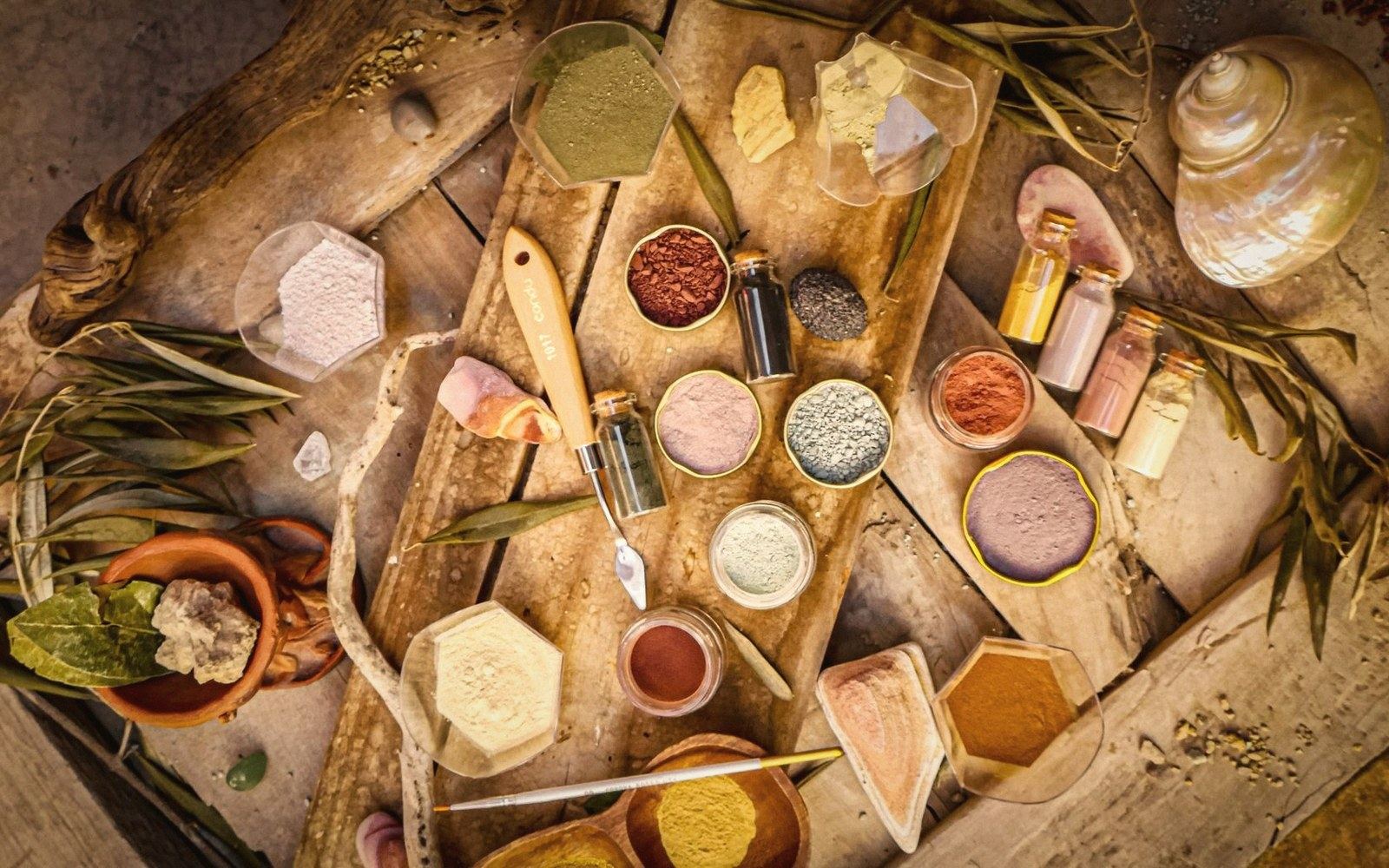
Raw earth pigment powder heaped on a glass grinding slab, close-up, warm studio light
Photo: Karelia Blum / PexelsLayer 4 of seven
PAINT
Pigment, binder, body — where colour comes from and why paint behaves the way it does under the brush.
Where PAINT sits
The stack, back to front, with band depth set by how much each layer carries here. PAINT is layer 4 of seven.
BEHIND IT ▼ GROUND
IN FRONT OF IT ▲ VARNISH
What to look for in this layer
- Pigment
- a solid, insoluble particle that gives colour by physically blocking and reflecting light; mechanically bound into a paint layerFrom “Why Some Colours Fade and Others Don't” →
- Fat paint
- paint with a higher proportion of oil; cures flexibly and more slowlyFrom “The One Rule You Cannot Break” →
- lead white
- a carbonate of lead that reacts with oil to form mobile lead soaps, which migrate upward through the paint film over decades or centuriesFrom “Colours That Will Not Sit Still” →
- Raw sienna
- yellowish semi-transparent brown; iron-rich earth with silica; quiet warmthFrom “Dirt, Fired and Ground” →
Everything in PAINT
4 pieces.
- Why Some Colours Fade and Others Don'tExplains the physical difference between pigment particles and dye molecules — how one is bound to the surface and one stains through — and why this is the root cause of differential fading in old pictures.2 min read
- The One Rule You Cannot BreakA focused explainer on the fat-over-lean principle — oil ratios in successive paint layers — and what happens structurally when it is violated. Written as a piece about why something goes wrong rather than as instruction.4 min read
- Colours That Will Not Sit StillExamines the physical movement of certain pigments in drying oil — lead white's vertical migration, bitumen's perpetual softness — framed as a mystery that materials science has mostly, but not entirely, solved.3 min read
- Dirt, Fired and GroundA concise history of the earth pigments — raw and burnt sienna, umber, yellow ochre — tracing their geological origin and their continuous use across roughly five centuries of European panel and canvas painting.8 min read