PAINT — layer 4 of seven
The One Rule You Cannot Break
Every oil painter learns it eventually. Some learn it from a book; others learn it from a cracked painting.
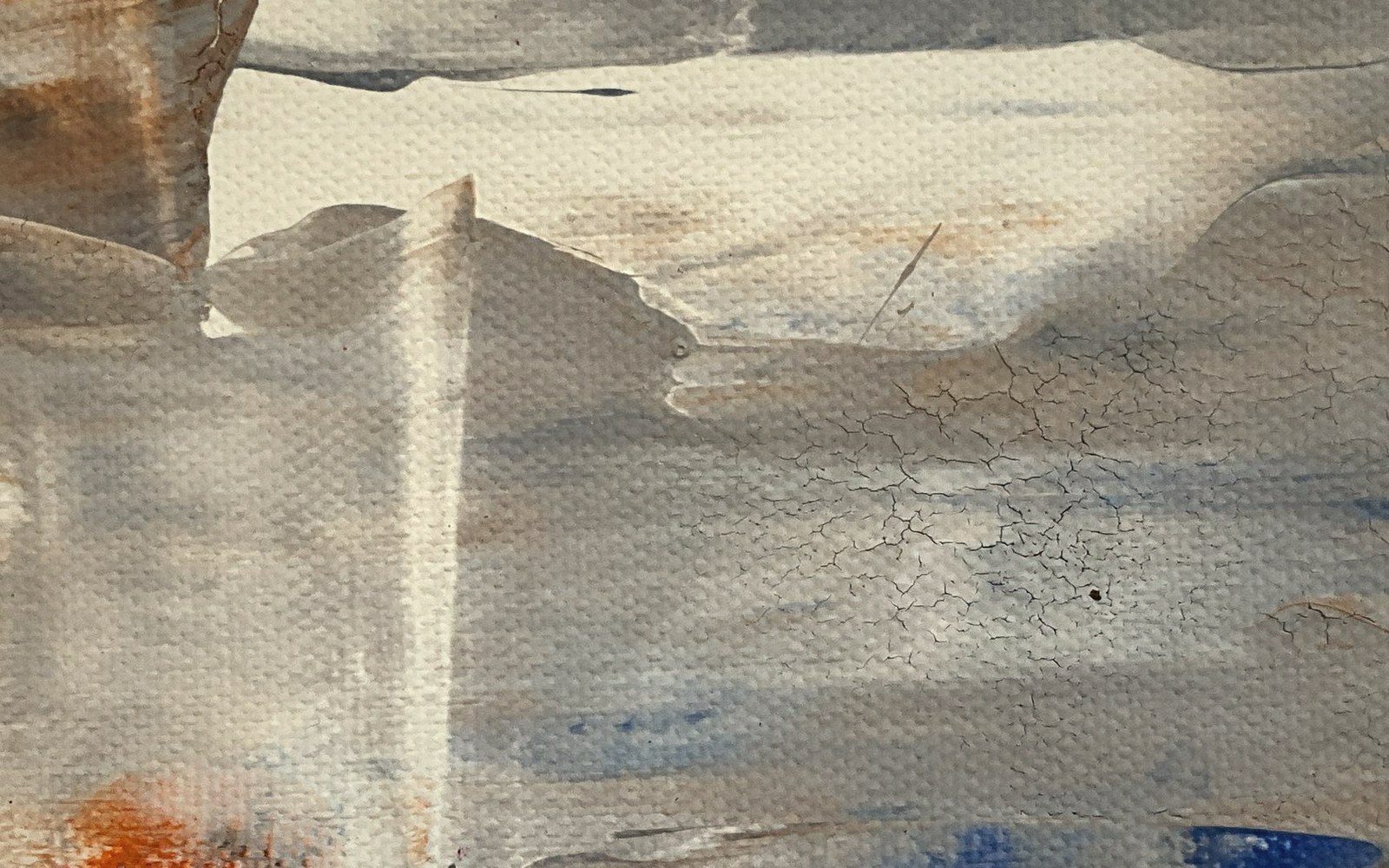
Why oil paint doesn't dry — it cures
Oil paint does not evaporate. It polymerises: the linseed, walnut, or safflower oil in the paint reacts with oxygen and slowly converts from a liquid into a flexible solid. That conversion takes time — weeks for a thin layer, months for a thick one — and it involves a measurable change in the paint film's volume. As the oil cures, it contracts very slightly and becomes stiffer. Add more paint on top before that process is complete and you have two films trying to move at different rates while bonded to each other. Something will give.
The fat-over-lean principle exists to manage exactly this. “Fat” means oil-rich paint — paint to which extra medium has been added, paint that stays flexible longer and moves more as it cures. “Lean” means paint used straight from the tube or thinned with solvent alone, with less oil, curing harder and faster. The rule is simple: every successive layer of paint should be at least as oil-rich as the layer beneath it. Fat on top of lean. Never the reverse.
What breaks when you get it wrong
When lean paint goes over fat, the underlying layer is still moving — still mid-cure, still contracting — while the top layer has already locked off into a rigid film. The rigid film cannot accommodate the movement happening beneath it. It cracks. In the trade, this pattern is called craquelure, and while all old oil paintings eventually develop some, the premature kind — the kind caused by lean-over-fat — is distinctive: the cracks appear early, run against the grain of the composition, and tend to follow a harsh, angular map rather than the soft, even network that comes with centuries of simple age.
The worst outcome is cleavage: the lean layer actually lifts away from the fat one beneath it, curling at the edges of each crack. Once a paint film has cleaved, the mechanical bond between layers is broken. What was a single object — a painting — has become a layered structure whose layers are separating. This is the failure mode that makes conservators wary and that no amount of surface treatment can fully reverse.
The physics are straightforward. A fat paint film can flex around a slower-curing neighbour; a lean one cannot. Think of it as laying stiff cardboard over a slowly drying rubber sheet. As the rubber shrinks, the cardboard doesn't follow — it fractures instead.
Why painters break the rule without knowing it
The most common violation is innocent. A painter lays in an underpainting — sometimes called a dead colour layer — thinned with mineral spirits or turpentine to make it dry fast and create a workable foundation. That layer is maximally lean: it has had oil removed, not added. Then, impatient to get back into the work, the painter begins layering richer paint, perhaps even paint mixed with stand oil or alkyd medium, before the underpainting has properly cured.
Turpentine-thinned paint can feel touch-dry within hours, which is deceptive. The polymerisation process continues long after the surface stops feeling tacky. “Dry” in oil painting means something different than it does with a water-based material: the surface sets before the interior finishes curing, and a thick lean layer can still be mid-process days after it feels firm to the touch.
There is also the matter of different pigments curing at different speeds. Lead white and burnt umber are among the fastest-drying pigments; ivory black and vermilion are among the slowest. A mixed passage containing a fast and a slow pigment can create internal stresses within a single layer that compound any fat-over-lean miscalculation made between layers.
The old Flemish and Dutch painters — Rubens, Rembrandt, the workshop painters of Antwerp and Delft — understood this structurally. Their underpaintings were often done in lean earth colours and whites; their glazes, which came last, were maximally fat: resin-rich, oil-rich, applied over fully cured foundations. That sequence is part of why so many of those pictures have survived centuries with their surfaces relatively intact. The discipline was built into the method, not appended to it as a rule.
What looking tells you
You do not need laboratory analysis to spot the failure in a gallery. Stand at an oblique angle to the picture surface — the way raking light works — and you can often see the pattern of premature cracking as a slight topography. The cracks will have straight, mechanical edges rather than the soft, rounded lips of age-cracks, and they will sometimes follow the contours of thicker paint passages rather than the broader rhythms of the composition. In severe cases, the affected area will look granular or slightly raised, as though the paint has been pressed from beneath.
The principle is structural, not stylistic. It doesn't care what the painting depicts or what century it was made in. The chemistry of curing oil is the chemistry of curing oil, and a paint film that has locked off before the layer beneath it has finished moving will crack — not because the painter broke a convention, but because they put a rigid lid on a container that was still shifting.