LIGHT — layer 6 of seven
More Than Eight Seconds
A practical piece on how to look at a painting for longer than instinct allows — where to start, what to follow, how long different kinds of attention take to develop. The site's flagship piece on the act of looking.
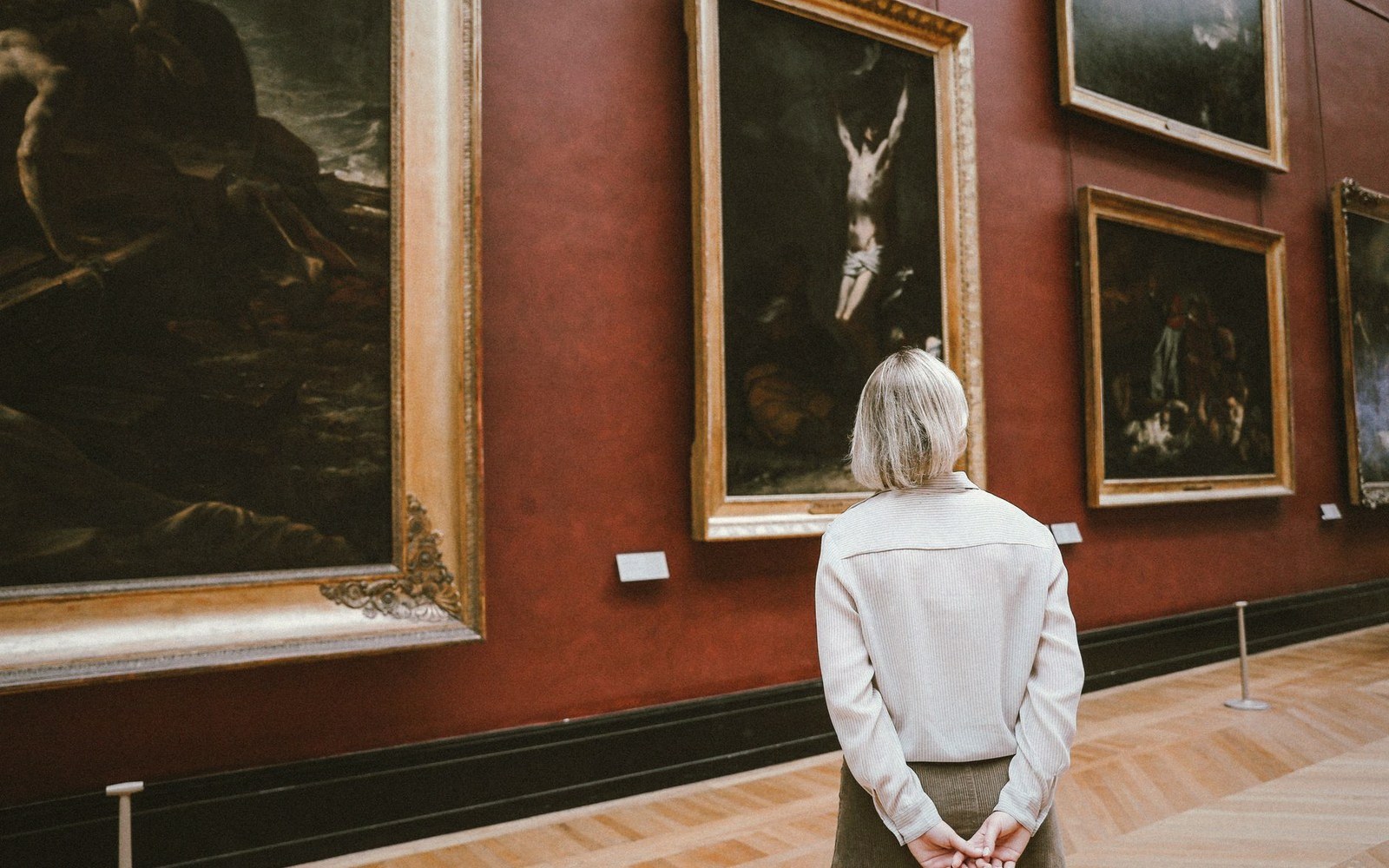
The visit most people actually make
You walk up to a painting, stand in front of it for somewhere between five and fifteen seconds, form an impression, and move on. That is not laziness — it is what instinct does. The eye finds an anchor point, the mind says I have it, and the legs carry you to the next thing. Museums and galleries are full of people doing this in good faith. The problem is that almost nothing about how a painting works is legible in eight seconds.
This is not a mystical claim. It is a practical one. A painting is a physical object — layered, textured, lit — and different parts of it take different amounts of time to come into focus. Some of what is most interesting to look at requires your eyes to stop moving. Some of it requires you to move your body. A few things only appear when your eyes have been resting on the surface for long enough that the brain stops pattern-matching and starts actually seeing. None of that happens in under a minute, and most of it happens only after two or three.
Where to start, and why it matters less than you think
There is no correct place to begin. You will hear that you should start with the whole, then move to parts; or that you should read a painting like a page, left to right; or that you should follow the artist's intended eye-path. Ignore all of this for now. The first thing to do is stop.
Plant your feet at a distance from which the whole painting fits comfortably in your field of vision without you turning your head. For a standard gallery-scale work — say, a canvas roughly a metre across — that tends to be somewhere between one and two metres back. Further back than most people stand. You will feel slightly exposed, slightly formal, which is fine.
Now look at it without deciding anything. Your eye will go somewhere — a bright passage, a figure, an area of strong contrast. Let it. Spend twenty or thirty seconds just watching where your eye wants to go. You are not analysing yet; you are logging the painting's initial pull on your attention. That information is actually useful later, when you start asking why here.
The second minute: surface and material
After that first settling, move closer. Not invasively close — you are not trying to read brushwork from three centimetres away, not yet — but close enough that the paint surface itself becomes part of what you are looking at rather than a transparent carrier of image.
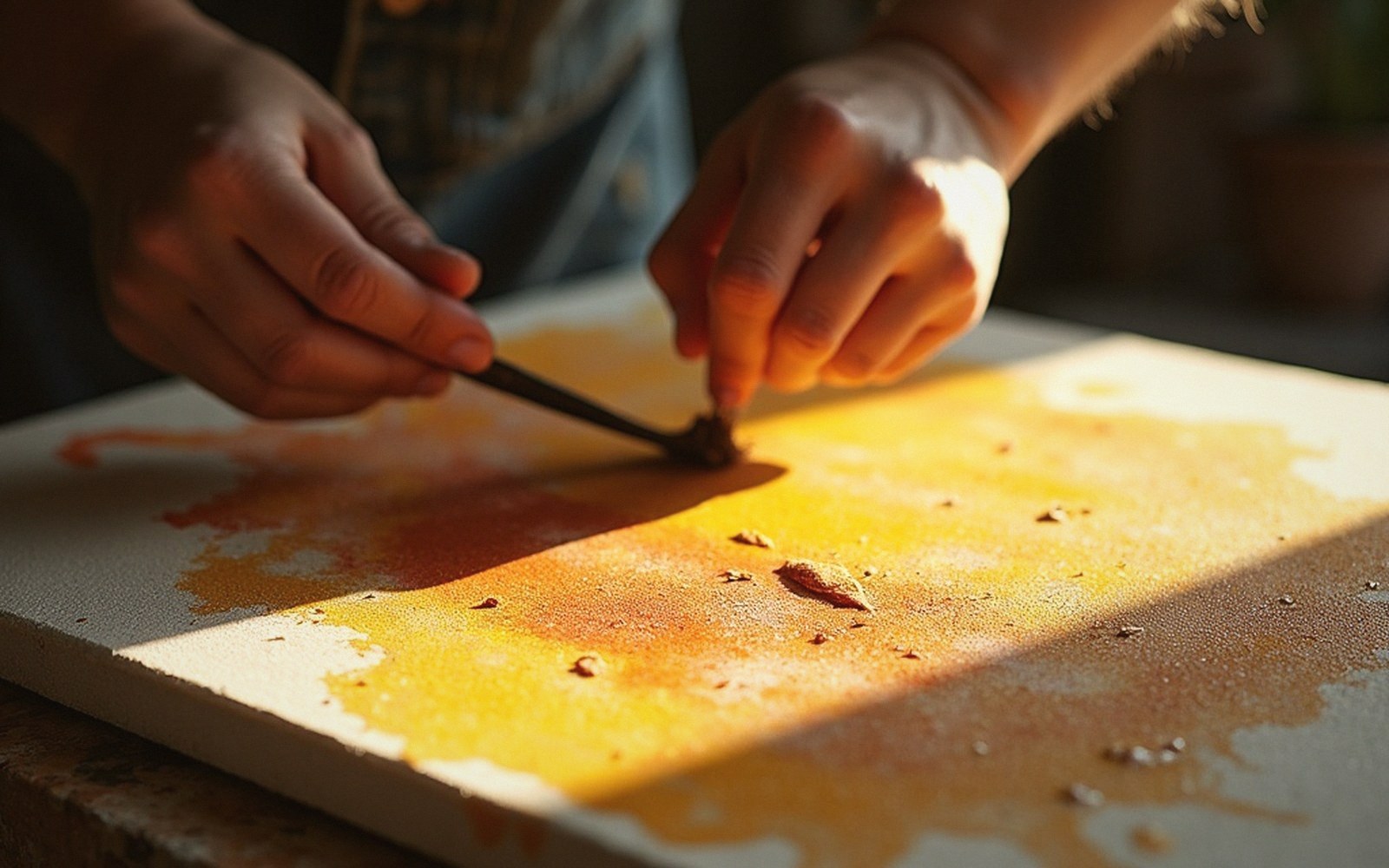
What you are looking for now is how the thing was made. Paint can be dragged thin so the ground shows through it; it can be piled up so it casts its own shadow; it can be worked wet into wet so colours blend on the surface rather than in a palette; it can be applied in discrete, dry strokes that remain separate and readable. None of this is visible from gallery distance, and all of it changes what the painting actually is.
Run your eye across the surface at a low angle in your mind — meaning: think about how the paint sits rather than what it depicts. Where is it thick? Where has it been scraped back? Are there areas where the ground colour is doing visible work, coming through a thin passage and warming or cooling what sits above it? Coloured grounds can remain active in the finished painting in ways that take sustained looking to notice — a warm ochre ground flickering through shadow passages, slightly shifting the colour without reading as a deliberate mark.
If the gallery has reasonable raking light — a single source set low and to one side — you may not even need to change your angle. The light does it for you, throwing any raised paint surface into relief and making brushwork and texture suddenly three-dimensional. If the gallery is flatly lit, you can sometimes simulate this by crouching slightly, so the light source is less perpendicular to the surface. A small shift in your eye height produces a surprising change in what the surface reveals.
The third minute and beyond: following edges
By now you have let your eye settle, you have looked at material, and you are probably three to four minutes in. This is where most gallery visitors have long since left. This is also where the painting begins to be genuinely interesting.
Edges are where painters make decisions they cannot hide. The edge between two forms — a shoulder against a background, a shadow against lit flesh, a dark tree line against a pale sky — is where a painter either commits to a hard line or softens it, blurs it, loses it entirely. These choices are not decorative. They govern how the eye moves across the surface and how forms feel — present or receding, tangible or dissolved. A face in a portrait where every edge is crisp will feel different — harder, more confrontational — than the same face rendered with half its edges lost into shadow.
Follow one edge. Pick the most prominent boundary in the painting and trace it across the surface, slowly, with your eye. Notice where it firms up and where it dissolves. Then find a shadow edge: the line between lit and unlit on a single form. Painters who work in the tradition that descends from Leonardo's sfumato frequently let this edge blur and migrate — it is not a line so much as a gradual shift — while painters working from a tradition of sharp, drawn contour hold it tight. Neither is correct; both are decisions, and both are visible only if you take the time to trace them.
Once you have followed edges for a minute or two, go back to your original distance. The painting will look different. It will have more internal structure — you will feel the eye path through it more consciously — because you have now been close enough to understand how the forms are built. That shift in reading is the reward for the extra time.
What to do when you feel nothing
Sometimes you stand in front of a painting and feel genuinely indifferent. This happens even to people who care about looking. The instinct is to give it a few seconds and move on; but indifference at eight seconds is not a verdict on the painting. It is mostly a verdict on eight seconds.
A useful strategy: pick one material fact and pursue it. Not do I like this but what is the ground? Is it white, or toned? You can sometimes tell from the edges of the canvas if it is unframed, or from thin passages where the paint has been applied lightly enough that the ground colour pushes through. Or: what is the thickest paint in this image? There is almost always one area where a painter has loaded the brush or the knife most heavily — a highlight, a textured foreground, a focal point where they wanted physical weight. Finding it gives you a material anchor, and material anchors have a way of pulling everything else into focus.
This is not a trick to fake enthusiasm. It is the observation that affect — the feeling of a painting mattering — tends to follow from looking, not precede it. Eight seconds is too short for that process to complete. Most people who have spent twenty minutes in front of a single painting report that the experience was different in kind from what they expected at the two-minute mark. Not all of them would describe it as pleasure, but all of them describe it as more.
A practical structure you can try once
First thirty seconds: full view, let the eye go where it goes, note the anchor point. Minutes one to two: move closer; look at the surface as a physical thing — paint thickness, ground showing through, brushwork character. Minutes two to three: trace edges; follow two or three boundaries across the surface slowly. Minute three onward: step back to original distance and look again.
The total is five to six minutes for one painting. In a long gallery visit that is a significant investment in a single object. But it is also a different kind of visit — you leave the building having actually seen something, rather than having walked past a great many things.